Project archive
Conductor
Multi-tenant NetSuite–Shopify replication, with the observability to trust it.
- My role
- Creator and main author, 69 of its first 75 commits
- When
- October 2026 — present, at Prosper Digital
- Original
- conductor.pike.network
- Archived
A copy kept here in case the original moves, goes offline, or I lose access to it.
Conductor keeps NetSuite and a group of Shopify stores in step: products, stock, prices, tax flags and fulfilments flow out to the stores, and orders and customers flow back. I built it at Prosper Digital as a product rather than a one-off integration, so each client gets its own workspace on one platform. Its interface follows Shopify admin conventions.
The original runs behind a sign-in, so these screenshots come from its simulation workspace, with example stores and simulated endpoints.
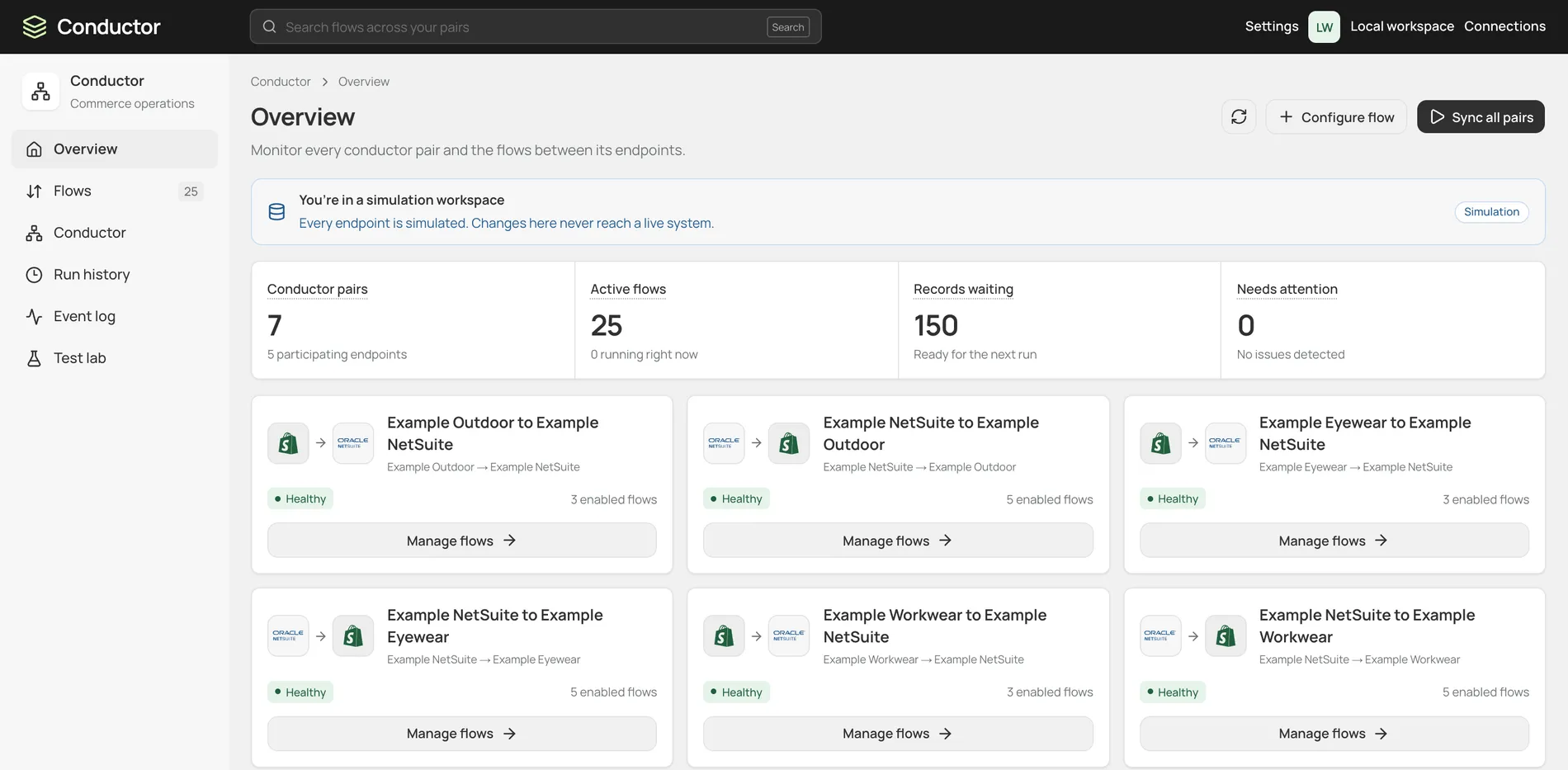
The model
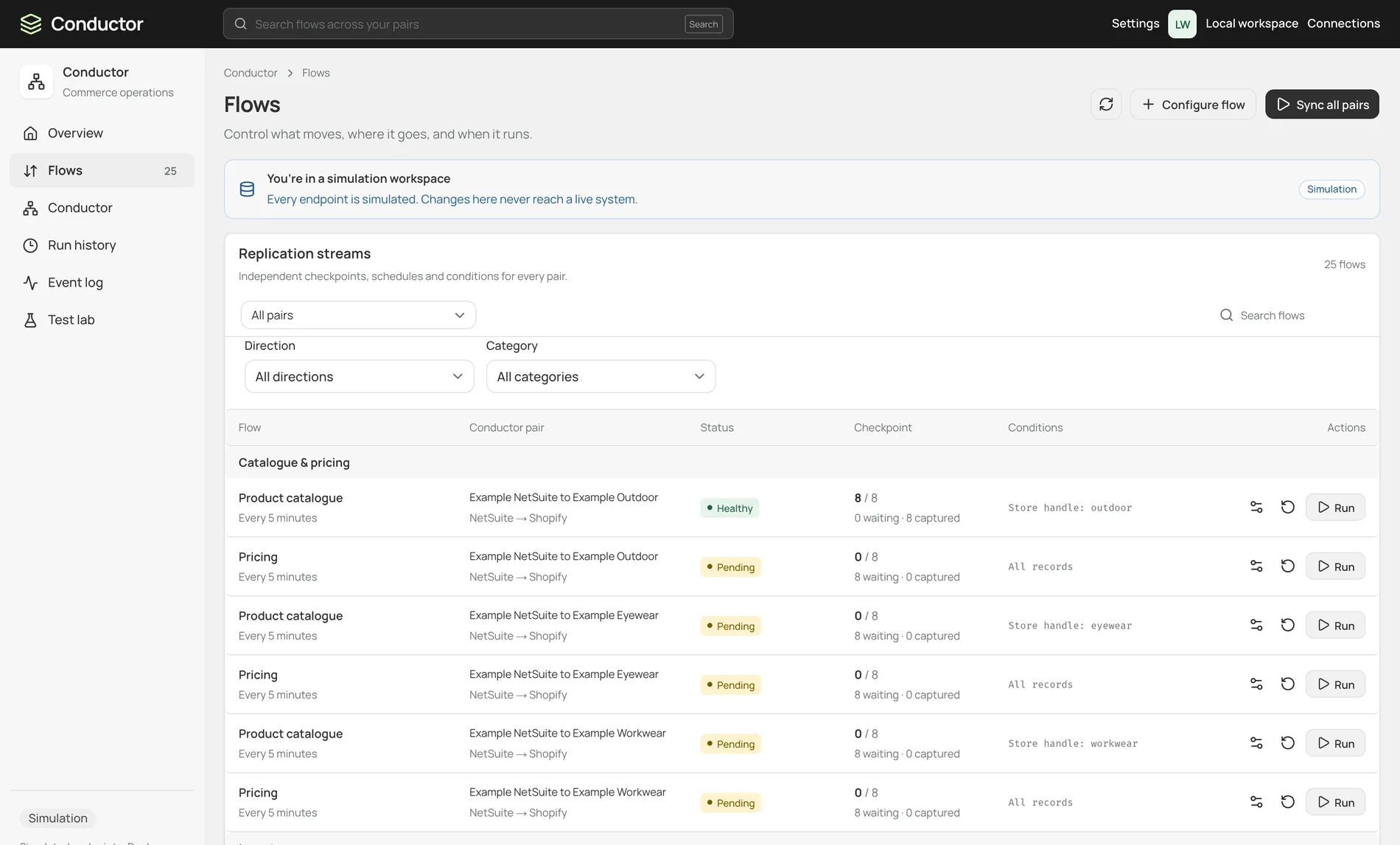
An endpoint is an account or a store. A pair is a one-way route between two endpoints. A flow picks a pair, a schedule and the conditions a record must meet. Adding a store provisions its endpoint, two pairs and eight paused flows, so the configuration can be reviewed before anything runs.
- NetSuite → Shopify: products, available inventory, pricing, product taxability, fulfilment and tracking.
- Shopify → NetSuite: B2C orders, B2B orders and customer profiles.
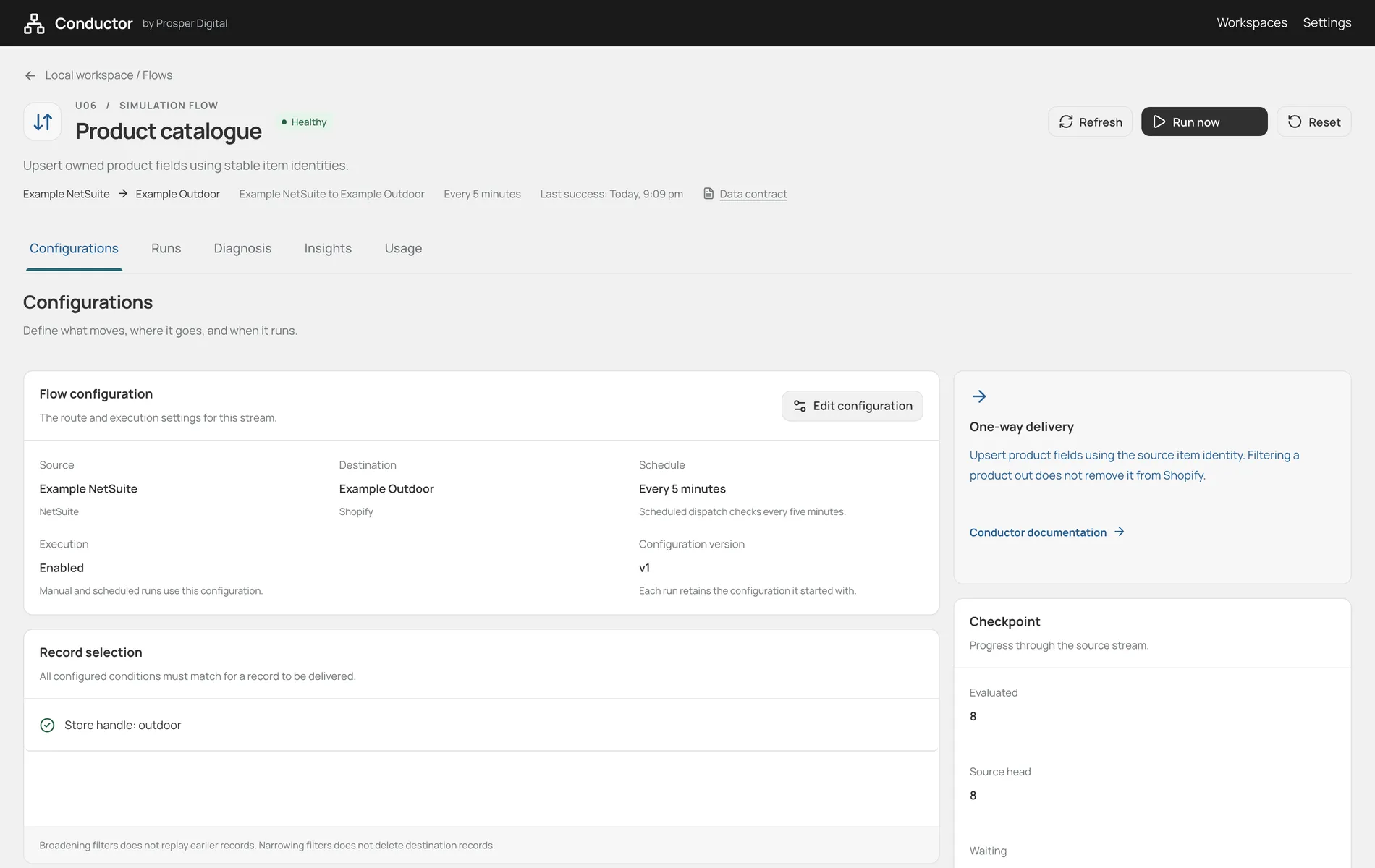
Each flow has its own configuration screen with domain controls (store handle, warehouse, price list, SKUs, countries) rather than a shared expression editor.
Replication guarantees
Delivery is at least once with idempotent effects, not a claim of distributed exactly-once transactions:
- One owner per stream. Manual and scheduled runs reserve the same stream atomically.
- Each run freezes its source boundary and snapshots its configuration, so a run always knows what it was told to do.
- Every page of records is written to an immutable journal before any destination is touched.
- Pending writes are persisted first and retried with the same key. Orders are create-only, and a failed write is never skipped over.
- Runs can be paused, resumed, replayed from the journal, or reset to resync without sending an order twice.
Observability
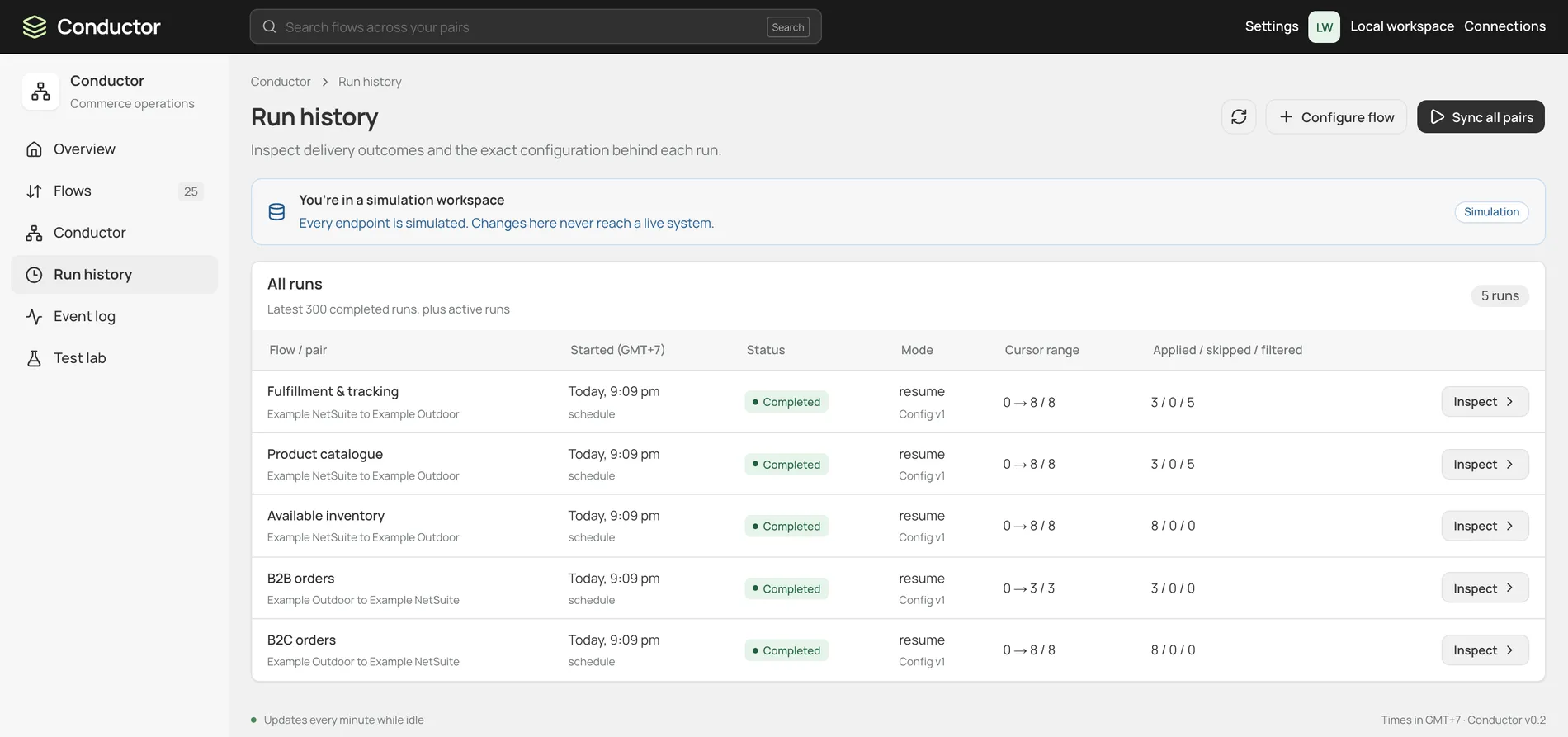
Run history shows each run's mode, cursor range, configuration version and how many records were applied, skipped or filtered. An event log follows every record, and a test lab injects stock changes, orders, failed writes and lost responses to rehearse recovery.
Built with
Next.js 16, React 19, Vercel Workflow for durable runs, Upstash Redis, Clerk organisations for multi-tenant access, and Base UI. Tenants' data, journals and runs are partitioned, and cron dispatches a fair share of streams per tenant every five minutes.